
Sourdough – Three Years Later…
Back in 2022, I published this post about my first attempt at a loaf of sourdough. And I haven’t thought much of it over the last three years as I’ve continued to make sourdough. Until this morning when I woke up to this comment – “Sorry but that looks terrible, people new to sourdough don’t follow this“. At first I was hurt. And then I had to laugh. Because my sourdough did look terrible. But nothing will take away my pride from that very first loaf I worked and baked – even though it was overproofed and underbaked. We all have to start somewhere, right? Three years later, “Aunt Bea” is producing loads of sourdough bread, pizza dough, pancakes, cookies, quick breads, english muffins, bagels, and more! So, if you’re unsure of starting. Just do it. You’ll be so proud of yourself!
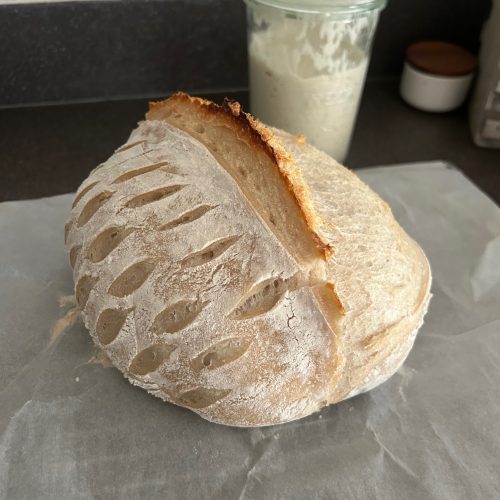
Sourdough Bread
Ingredients
- 100 grams starter (active and bubbly)
- 350 grams warm water
- 500 grams bread flour
- 10 grams salt
Instructions
- First, on a basic kitchen scale, add your starter to a bowl. Then the water. Mix the starter and water with your hands until it’s “milky”. Then add your flour. This makes two hearty loaves so make sure you are using a BIG bowl. Then, remove the scale from under the bowl and mix the starter, water, and flour together. You’ll mix it with your hands for 2-3 minutes by picking it up and folding it over on itself. It will be very sticky.
- Next, cover it with a dinner plate and let it rest for about an hour (autolyse). After that hour start your “stretch and fold” method. Pull the dough upward, shake it out a bit, and then fold it on itself. I did this for about 3 minutes. Put the plate back on your bowl and let it rest for 30 minutes.
- Over the next few hours, you will create structure to your dough by doing 4-6 sets of stretches and folds. For each set, stretch the dough up and over itself 4 times. Leave about 15 minutes between sets.
- Once you've finished your stretch and folds, place the plate back on your bowl and let it bulk ferment until your dough doubles in size (about 2 hours).
- Once the bulk ferment is done, you will shape your dough into a boule (round) or batard (oval). Flour your countertop with flour. Flip your dough onto the countertop so the smooth side is down. Pull the edges of the dough into the center and then flip it over so that the sticky side is now underneath. Using the stickiness, gently pull the dough into a tight ball.You will need a banneton to put your dough into. If you do not have a banneton, then a bowl or basket lined with a floured tea towel is perfectly fine. Make sure your bowl isn't too big though, you want your dough to retain some shape. Whatever you're using needs to be liberally floured.
- Once the dough is shaped into a tight ball, place it into your banneton smooth side down, so your seam is on the top – this way the top of your dough will get the pretty lines from the banneton.
- Now the dough is in its "shaping container" cover it loosely with a plastic bag or damp tea towel and place into the fridge. I like to leave my dough in the fridge overnight to bake first thing in the morning. The longer you leave it the better your bread will be!
- Once you're ready to bake your sourdough, you'll need to preheat your oven to 450F. Place your Dutch Oven into the oven when you turn it on so it gets HOT. Leave your dough in the fridge until the very last minute – placing a cold dough into a hot oven will give you a great "spring".
- When your oven is at temperature, take your sourdough out of the fridge. Gently place it onto a piece of baking paper. Make sure that you make the baking paper big enough to use the edges as a handle to lower to dough into your Dutch Oven. Gently score your bread with a lame, clean razor blade or knife. At minimum a large cross is sufficient, but you can get as artistic as you like. Carefully take your dutch oven out of the oven. Place the sourdough into the pot using the baking paper as a handle. Put the lid on and place into the hot oven.
- BAKE TIME: 30 Minutes with the lid on at 450F then 10-15 Minutes with the lid off at 400F. When you remove your dough from the oven, carefully remove it from the dutch oven as soon as possible and place on a wire rack to cool. Remember not to cut into your loaf too soon – you'll need to let it cool for at least a couple hours.


Not the same person, unfortunately but that sourdough bread looks simply amazing! Great job on the progress 🙂
Thanks so much! The point is, we all start somewhere!
I’ve tried lots of recipes and watched lots of videos as a newbie to sourdough. I like your recipe and instructions the best.
Now I make it 2 or 3 times a week. Easy to follow and always turns out great.
Thanks you.
I’m so happy to hear this feedback! Keep baking!